“To achieve true success, businesses must have a mission that extends beyond mere profit.”
– Marc Benioff (CEO, Salesforce)
Many tech CEOs and founders make a dangerously simple assumption: “We offer 30% margins, so partners will be highly motivated”. They believe that if their direct sales team can sell the product, external partners naturally will too, and if partner can make good margin on their solution, they it’s a no brainer.
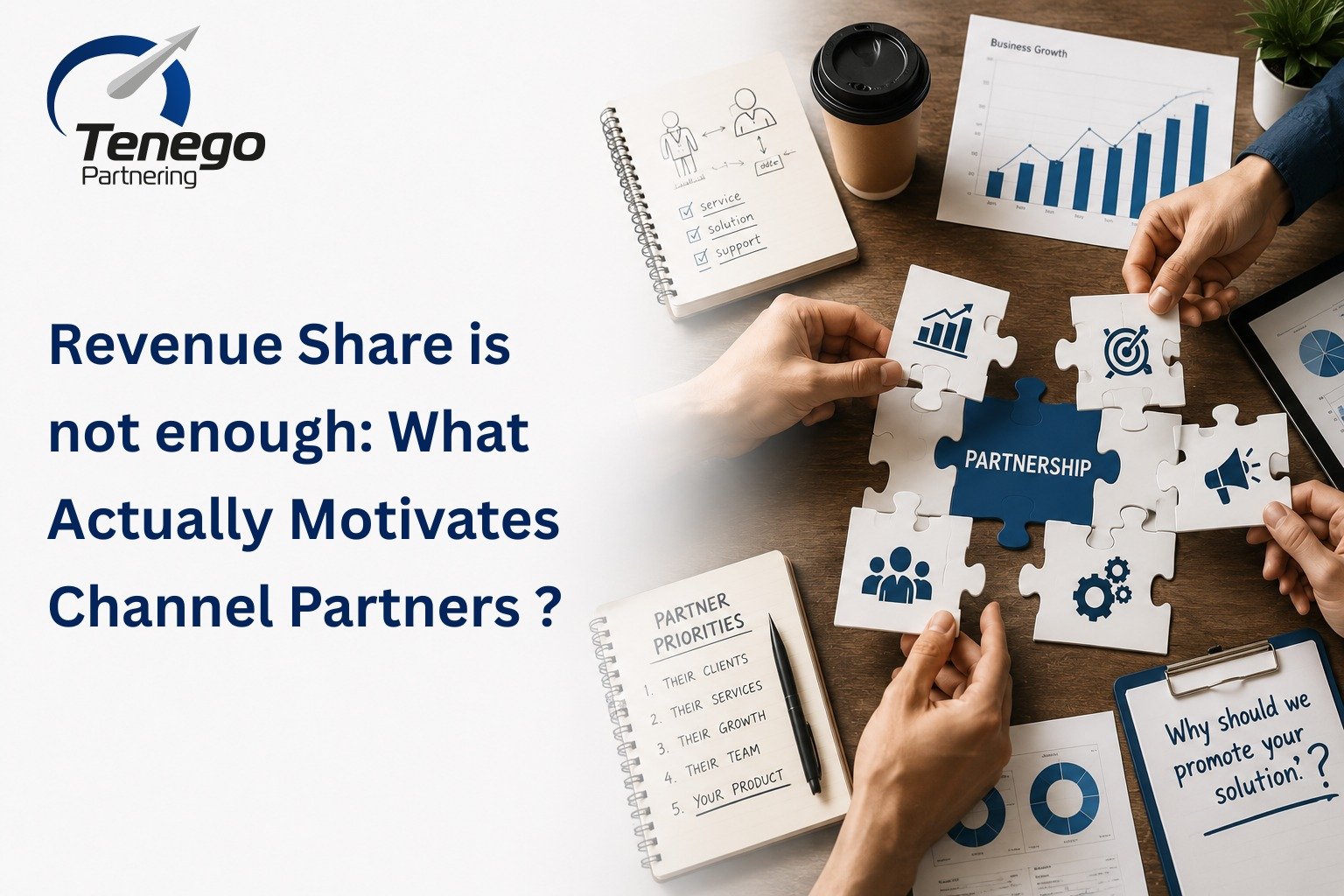
The bottom line up front: Revenue share alone is not enough to motivate a busy channel partner. Making money off your software license margin is often number five on a partner’s priority list.
When you ask, “What’s in it for the partner?”, the knee-jerk answer is almost always “Revenue Share”. But throwing a percentage at an independent business and expecting them to drop their core focus to sell your software is a fundamental misunderstanding of what makes partnering work.
The Challenge: Why Margin Fails to Motivate
If you rely on margin alone, how much of your revenue will you need to give away, and is your solution so good, and partnership so aligned that the partner would recommend your solution anyway?
Your partner proposition needs to compete for the partners’ attention with other safer more lucrative revenue opportunities.
You must look at the whole picture of what makes a partnership work. Partners do not want to buy your software; they build a business around it. Partners are driven by resulting revenues within their own specific business models, billable services, and existing portfolio of offerings. If Microsoft offers a 30% revenue share, their partners also earn an estimated $9.58 in related services and software for every $1 Microsoft generates. Without a massive multiplier in resulting services revenues, your “license fee-only” proposition will be entirely ignored.
You must also realise that different partnership types, company sizes, and market focuses require entirely different business drivers:
- Consultants: Operating in the SMB to enterprise space, consultants fiercely protect their position as independent advocates for their customers. If you try to ‘bribe’ them with a referral kickback, they will actively refuse your commission to protect their trusted advisor status. They want lucrative, billable service hours, not a referral fee.
- Resellers and Managed Service Providers (MSPs): For SMB and mid-market focus, MSPs want low-touch, high-volume solutions that embed seamlessly into their multi-year managed contracts. They are driven by fast sales, transactional volume, and scalable support.
- Value-Added Resellers (VARs) and System Integrators (SIs): These partners do not just resell simple software; they focus on complex solutions that require expertise before and after implementation. They are driven by service revenues first and software license margins second, focusing heavily on medium to large deals that require deep customisation, configuration, and integration. While they are highly credible, proactive, and experienced in partnering, getting them to actually engage is a massive challenge because they are bombarded with options from other vendors. To win their mindshare and overcome their slow decision cycles, you must offer them massive billable service opportunities, proven solutions, and very strong technical and sales support.
You can’t offer the same generic partner proposition to a niche SMB consultant as to an enterprise SI. They are motivated by different business models. If you are not explicitly demonstrating how your solution fits seamlessly into their specific existing portfolio to reach your shared Bullseye Target Customer, you are creating a compounding strategic liability.
The Hard Questions
Before you burn more of your runway executing your current strategy, take these uncomfortable questions into your next team meeting:
- The “Margin is Motivation” Reality Check: Are we operating under the delusion that simply offering a 30% or 40% software license margin is enough to motivate a partner, completely ignoring that revenue share is often number five on a partner’s priority list compared to meeting core customer needs or winning new business?
- The Services Multiplier Exposure: Does our partner proposition explicitly map out a partner’s potential ongoing resulting services multiplier (such as implementation, data migration, and training), or are we missing the point by pushing a ‘license fee-only’ pitch?
- The No-Brainer Deal Blind Spot: Do we blindly assume a partner will drop what they are doing to focus on our solution, instead of explicitly demonstrating how our solution seamlessly integrates into their current offerings to help them sell more of their own core services?
Take the Positive Path
If you have been offering massive software margins to partners who aren’t selling, do not be discouraged. The great positive here is that you have clearly demonstrated a willingness to be generous and financially reward the companies that work with you. That collaborative mindset is a great starting point for building partner trust.
You have the right ambition, but do not try to fix this problem with more internal guesswork or “action before clarity”. You simply need to redirect that investment into the operational services your partners actually care about. Great partner propositions are built on The Three Pillars of Partnering Success: Partner Fit, Partner Proposition, and Partner Enablement.
To stop guessing and find out exactly where your partnering strategy is not delivering. Take the Tenego Partnering Diagnostic to uncover your ideal partners’ exact value levers, and explore our courses to build an evidence-based roadmap that actually works. Visit Tenego.com